


At CARE LAB Divas, we believe supporting young talents is crucial. That's why we've decided to support young Slovak triathlete Aleš Czucz, who, at 18, has already achieved several impressive placements in domestic races. As he himself says, hard work beats talent, and believe us, he truly "grinds" hard. In our interview, he revealed how he got into triathlon, what his training plan looks like, and whether it's even possible to balance it with studying. He also introduced the events awaiting him in the near future, as well as his career goals and dreams.
Hi, Aleš. Let's start from the very beginning. Can you tell us how you actually got into triathlon? After all, it's a specific sport that requires versatile athletic talent, or at least a love for all three disciplines – running, cycling, and swimming.
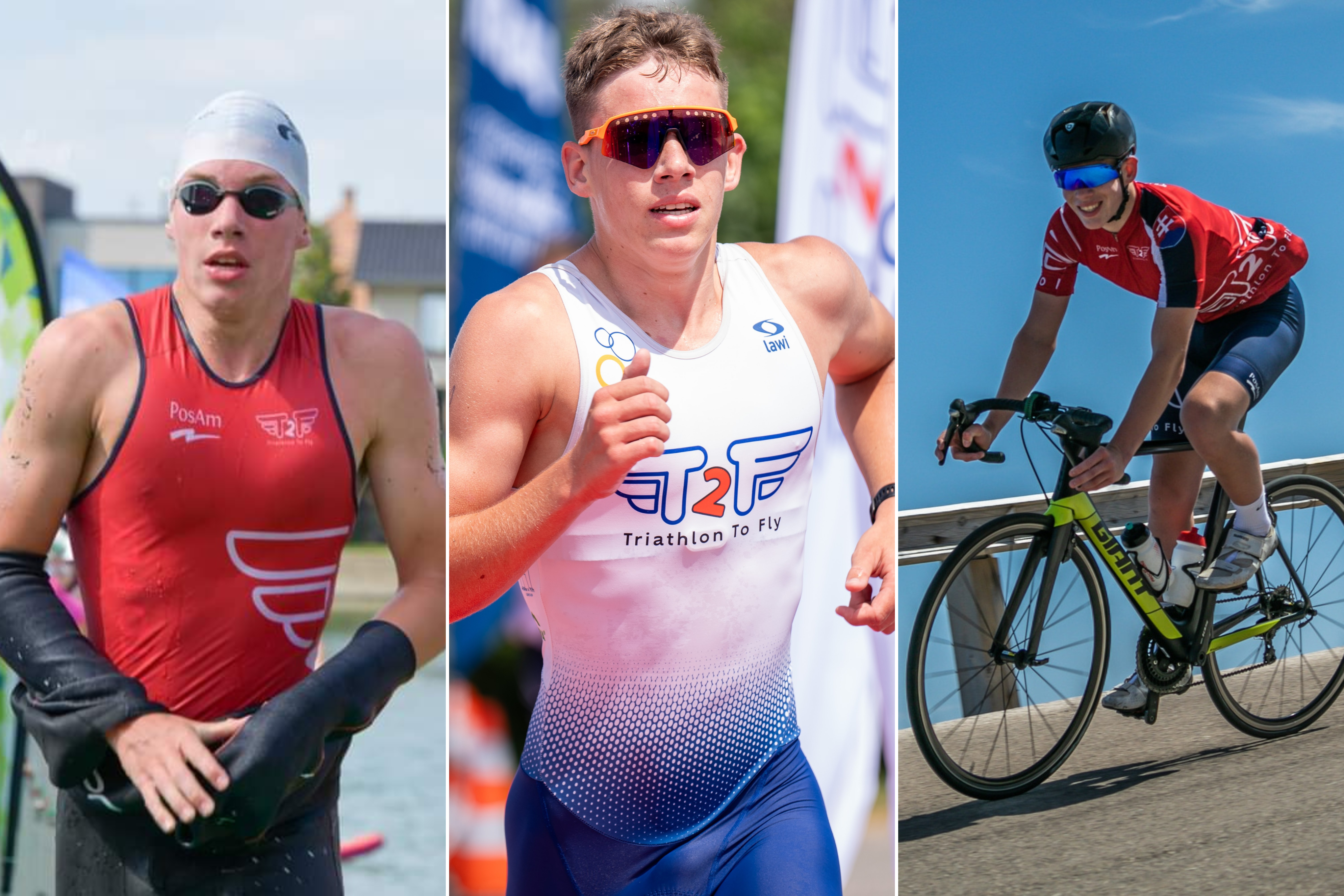
My parents encouraged me to be active from a young age, whether it was hiking, skiing, swimming, or cycling. They cared about me being active and healthy. At a competitive level, like most boys, I started with football, later moved to Greco-Roman wrestling, and kayaking also tempted me. I got into triathlon thanks to my mom, who spent a year preparing for a sprint triathlon (750m swim, 20km cycle, 5km run). It was at her race that the atmosphere and the combination of the three disciplines captivated me. I really liked the versatility of the sport, so I started to take an interest in it. I bought a road bike (my parents paid half), found the TRI2FLY triathlon club in Šamorín, and at 14, I gradually started training.
So family plays a crucial role in your sports career...
My family has supported me from the beginning and is very keen for me to achieve my goals. My parents are at almost all my races, which I really appreciate.
Do you enjoy all three triathlon disciplines equally, or did you have to gradually build a relationship with some of them?
Now, after almost five years of training, I can say I enjoy all three disciplines, but initially, I had to build a relationship with swimming. I enjoyed it, but I wasn't very good at it. Since I never really swam properly, it was challenging. It took me three years to start feeling comfortable in the water.
"My parents encouraged me to be active from a young age, whether it was hiking, skiing, swimming, or cycling. They cared about me being active and healthy."
We assume it's not possible to train all three disciplines every day. So, what does your typical training plan look like?
Triathlon is a time-consuming sport, and proper time management is crucial. I train 14-20 hours a week, and my training week looks roughly like this:
Monday: 40 min run, 1h swim
Tuesday: 1 – 2h bike, 1h swim
Wednesday: run training – 1h
Thursday: 1 – 2h bike, 1h swim
Friday: 1h strength training, 40 min run
Saturday: 3 – 4h bike
Sunday: 1 – 1.5 h run
I try to do most of my training in a group because it's more fun then, and the training passes faster. Due to time constraints, I sometimes have to do some training sessions individually.
Of course, when I have a race, the training plan looks completely different. It's also important to mention that each training session has a different intensity, meaning I don't go full out every day.

Planning and, especially, coordinating all of this must be quite challenging. Can you introduce us to your coaching team that participates in this?
Patrik Čurila and Šimon Wahlandt are in charge of my cycling and running plan, and my swimming coach is Valerián Vančo. I have a friendly relationship with my coaches, I greatly respect them, and they are a great inspiration to me. In every training session, they give me expert advice, motivate me, and support me in overcoming demanding training and races.
"If you want to train properly, you must also recover properly."
Anyone who has ever done even a little bit of sport knows that "just" training is not enough. The best athletes often stick to a fairly strict routine (especially during the season), have a restricted diet, or an early bedtime. Is this also the case for you?
If you want to train properly, you must also recover properly. This means I go to bed early, usually around 10 PM, although it's not always possible due to school preparation. I don't have a special diet; I just try to eat a varied diet.
The life of an athlete is not easy. Friends often invite me out in the evening, but I have to decline because a tough training session awaits me in the morning. It's mainly about discipline – you can't succumb to temptation and have to focus fully if you want to achieve something.
Let's take a closer look at your lifestyle. Does your training process require any restrictions, special eating habits, or specific dietary supplements?
I eat a varied, balanced diet and try to avoid fast food. As for supplements, I take protein after training, drink an isotonic or electrolyte drink during training, and use energy gels during races.
You also mentioned school. We know you're in your final year of high school, which is tough enough on its own, let alone when you're fully committed to sports. How do you balance training with studying? Do you even have any free time?
Balancing sports and school is not easy, but it's about setting priorities. I usually wake up at 6 AM, get ready, and go to school. I come home at 4 PM, but I immediately get dressed and go for a run, for example. After training, I have about an hour to rest, and then I go to swimming practice. I get home around 8:30 PM, have dinner, and then prepare for school. I go to bed around 10 PM - 10:30 PM to be ready for the next day. As you can see, I don't have much free time. I go out with friends about once a month, and even then, only on weekends when I have a rest day. This is the downside of elite sports.

Now that we know a bit about how things work for you, we're curious about your current phase. If we're not mistaken, the season is in full swing. What events are coming up for you in the near future, and what will be the highlight of this season?
The season is in full swing, I just completed my first Olympic triathlon – Challenge Šamorín (1500m swim, 40km cycle, and 10km run). It's the biggest triathlon event organized in Slovakia, and I managed to secure 1st place in my category (18-29 years old) and 3rd place overall. Next, I'm heading to the Senec sprint triathlon on May 26th and the Slovak Super Sprint Triathlon Championships in Rovinka on July 21st. The highlight of the season for me is my debut Ironman 70.3 Zell am See, also known as a half Ironman (1.9km swim, 90km cycle, 21km run), which will take place on September 1st, 2024.
The question of stress is often associated with competing. Do you get nervous before races? If so, do you have any rituals that help you manage these situations?
I was stressed at my first race because it was something new, but now it's different. I am aware that I have trained well, and I know that I haven't missed a single training session in the last three months, so there's no reason for me to be stressed.
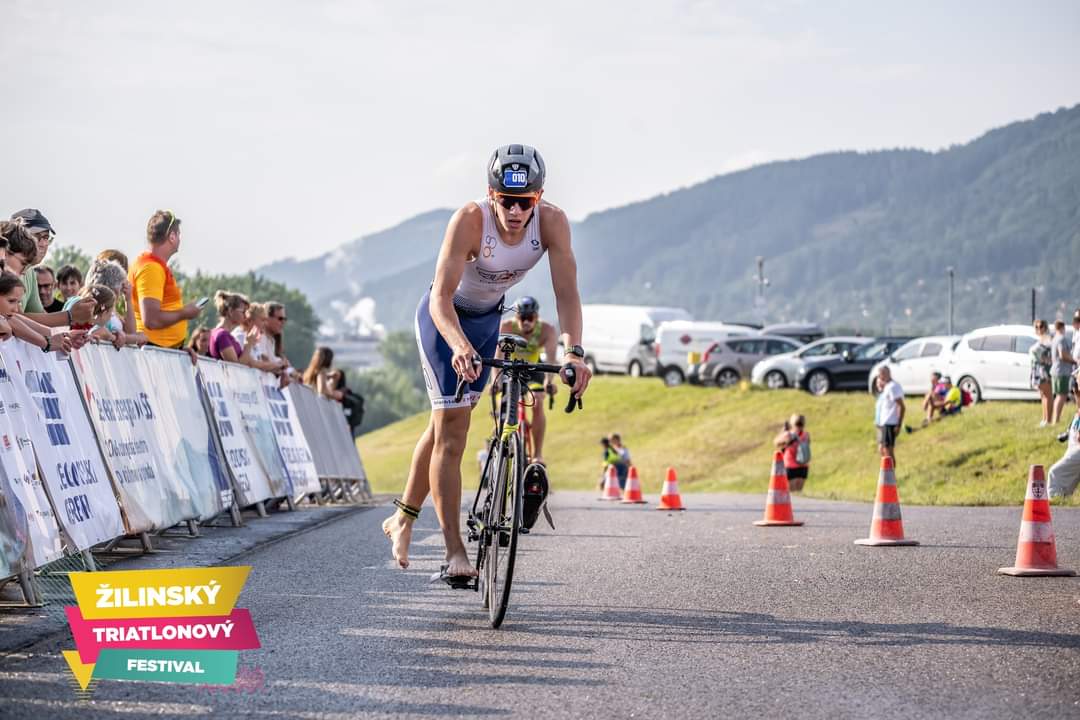
"It's mainly about discipline – you can't succumb to temptation and have to focus if you want to achieve something."
Anyone who has never done triathlon probably finds it hard to imagine everything this sport entails, what kind of equipment is needed. Are there any specifics or interesting facts about triathlon that would surprise us, the laypeople?
Triathlon is a very financially demanding sport and requires many things:
- For swimming, I need swimming goggles, a swimming cap, a triathlon suit, and if the water is cold, also a wetsuit.
- Cycling requires a road bike, helmet, glasses, cycling shoes.
- For running, running shoes and a race number belt are, of course, essential.
As for interesting facts, I would definitely mention the Ironman World Championship in Hawaii. This event is considered one of the most demanding endurance races in the world. It combines a 3.8 km swim, 180 km cycle, and 42.2 km run in challenging conditions with hot weather and strong winds.
It sounds really challenging and exhausting, but we hope you get to experience the atmosphere of such an event firsthand. If that's among your goals, that is. It is precisely big goals, dreams, and role models that often motivate young, ambitious athletes. Can you tell us about yours?
My role models include Kristian Blummenfelt and Jan Frodeno. Both are Olympic champions and multiple world champions in triathlon (Ironman and Ironman 70.3). My goal is to become a professional triathlete and compete at the highest level. I wish that what I enjoy doing could also support me financially.
We wish you the best of luck and thank you for the interview. And if Aleš's story interested you, you can follow his further steps on his Instagram, for example.
Aleš Czucz
Aleš Czucz is an 18-year-old athlete who fell in love with triathlon. Even during his final year of high school, he trains 14–20 hours a week, and his goal is to pursue triathlon professionally at the highest possible level. He already has several top 3 placements from domestic events in the youth and junior categories. His greatest achievements to date include 1st place at the Challenge Šamorín Sprint Distance 2023 and Super Sprint Triathlon Rovinka 2023, 2nd place at the Pressburg Triathlon 2023, and 3rd place from the Slovak Cup 2023.



